Andrew Olsson
January 14, 2026Egypt’s passive superstar? Comparing Mohamed Salah’s style of play for club versus country
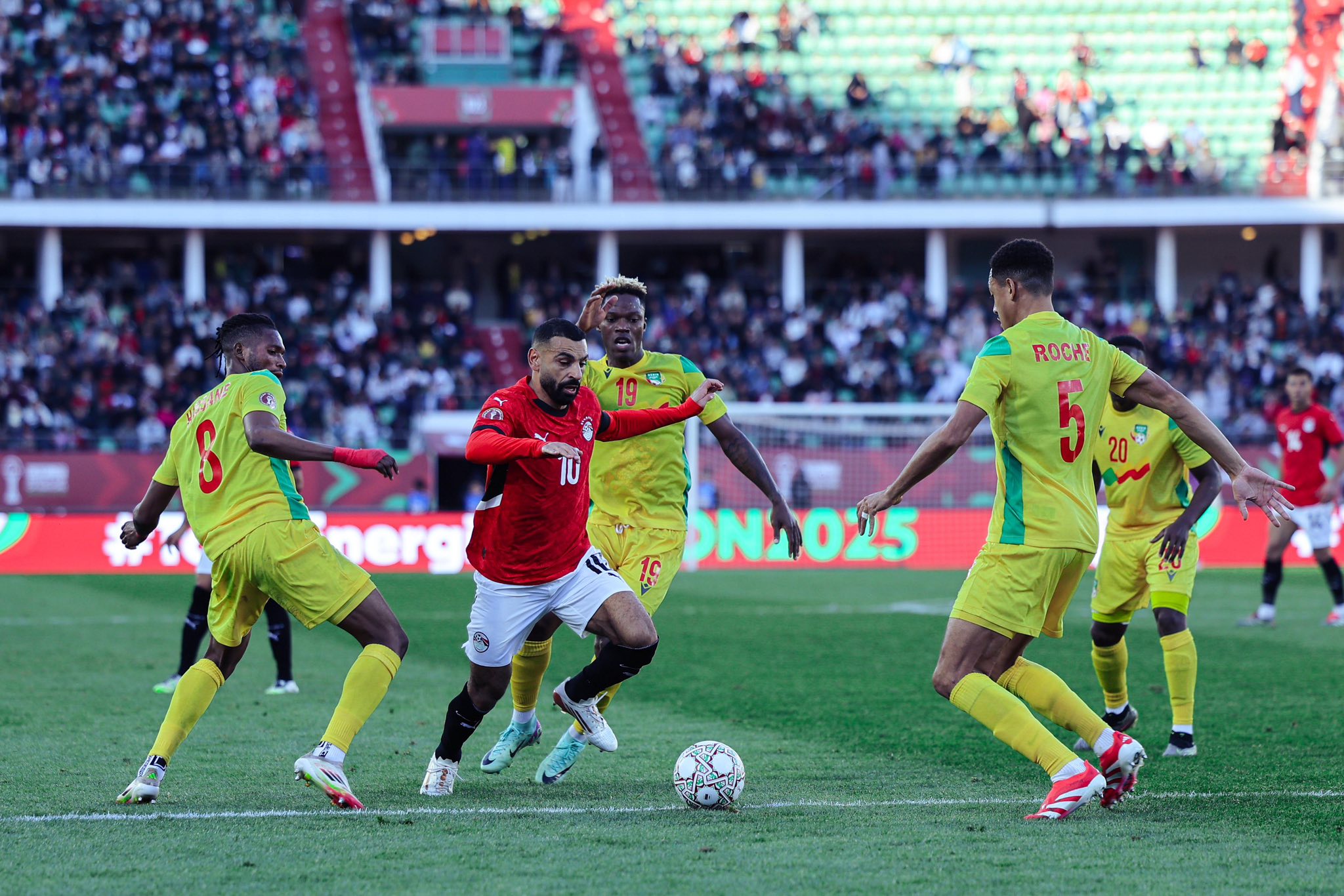
Photo: Egyptian Football Association
Egypt’s passive superstar? Comparing Mohamed Salah’s style of play for club versus country
In the midst of a transition into the twilight of his career, the 2025 Africa Cup of Nations is an interesting case study for Liverpool superstar Mohamed Salah as he attempts to lead Egypt to glory.
By any measure, four goals and an assist in four matches at a major tournament indicates impressive performances but it is a noticeably different Mohamed Salah on the pitch when he puts on the Pharoahs shirt.
Mo Salah’s left foot. Trivela. Enough said. 💫#TotalEnergiesAFCON2025 | #WePlayDifferent pic.twitter.com/ACVXDgOUEc
— TotalEnergies AFCON 2025 (@CAF_Online) January 6, 2026
Tied for second in the tournament in goals, there is no doubt that the Egyptian legend is doing his part. But there appears to be a lack of urgency, a lack of eagerness to run at defenders. At the same time however, it must be understood that Salah plays a different role with his nation.
First of all, Salah plays a much different role off the pitch with his nation compared to his club when it comes to leadership. At Liverpool, the Egyptian is not the primary captain but rather one of the several vice-captains and it appears that his elevated role with the Pharaohs reflects his different role on the pitch.
Salah is a reluctant leader with Liverpool but wants to get his teammates involved as much as possible with Egypt. To achieve this, the veteran attacker sacrifices opportunities to run at defenders in favor of looking for the pass that can unlock defenses and create goals.
There are couple of situations where Salah has multiple defenders close to him in the video above. But if a couple of these examples happened at Liverpool, such as the final clip when he is isolated with an Ivorian defender, a regular viewer of the English Premier League might assume that Salah would look to instantly run at goal and create a shooting opportunity for himself.
Is Salah attempting to conserve his energy until he is needed most? Until their quarterfinal clash against Ivory Coast, the path has not been too difficult regarding Egypt’s opponents. But even against potentially difficult foes like Ivory Coast and South Africa, Salah has hardly attempted any of his trademark dribbling runs or bursts into space. Below is a comparison of several notable statistics between the ongoing 2025-26 season with Liverpool and the 2025 Africa Cup of Nations:
| Statistic | Liverpool: 2025-26 | Egypt: 2025 AFCON |
|---|---|---|
| Offensive Duels/90 Mins | 9.92 | 13.5 |
| Attempted Dribbles/90 | 4.05 | 2.75 |
| Passes/90 | 29.82 | 34.5 |
| Penalty Area Touches/90 | 5.33 | 5.0 |
| Fouls Suffered/90 | 0.74 | 3.0 |
The numbers show that in fact, Salah is quite active in the Egyptian attack. The notable difference is the “attempted dribbles”, which measures something different from “attacking duels”. While “attacking duels” indicates moments when Salah has the ball and is engaged in a duel by a defender, “attempted dribbles” is a more specific category that includes times when a player attempts to manuever by a defender with the ball. The video below shows some examples of Salah engaged in “attacking duels” that shows why he has so many in each match at the AFCON.
So Salah has many “attacking duels” because whenever he receives the ball with Egypt, he is swarmed by opposing defenders. Often these duels come in the midfield when he drops back to be an outlet as Egypt moves the ball up the pitch. There are far less situations at Liverpool where Salah has to play with his back to goal while surrounded by multiple defenders. Most notably, there is no Trent Alexander-Arnold eagerly making overlapping runs in support… with all due respect to current Egypt and Al Ahly right back Mohamed Hany.
So Salah appears to be more passive at times with Egypt because he is attempting to initiate attacks compared to at Liverpool, where he has more talented midfield teammates to perform these duties while he can focus on creating and scoring goals. A look at the difference between how many fouls Salah suffers with Egypt at the ongoing AFCON compared to how many times he is fouled this season at Liverpool is a good indicator of how much space he has to work with when he plays for his nation.
Let’s compare these same numbers between Salah’s statistics at this Africa Cup of Nations tournament to his statistics at past editions:
| Statistic | 2017 (6 matches) | 2019 (4 matches) | 2021 (7 matches) | 2023 (2 matches) | 2025 (4 matches) |
|---|---|---|---|---|---|
| Offensive Duels/90 Mins | 8.17 | 14.75 | 13.69 | 6.0 | 13.5 |
| Attempted Dribbles/90 | 2.47 | 7.0 | 4.15 | 1.0 | 2.75 |
| Passes/90 | 24.04 | 24.0 | 19.8 | 22.5 | 34.5 |
| Penalty Area Touches/90 | 2.62 | 4.0 | 3.7 | 2.5 | 5.0 |
| Fouls Suffered/90 | 1.39 | 1.0 | 2.69 | 1.76 | 3.0 |
It appears that the initial hypothesis, that Salah is passive with Egypt, has been debunked by a closer statistical analysis. Salah does play a different role for Egypt but if anything, he is more involved in attacking team movements as a facilitator rather than a finisher. With Liverpool, he has more room to work with and more talented teammates who can create the situations and moments of isolation where we see Salah often thrive for his club.
But with the increased scrutiny and defensive attention given to Salah from opposing teams at the Africa Cup of Nations, there are far less moments for him to run at defenders in the attack without sacrificing opportunities for his teammates.
It is fascinating to see how similar the statistics are between the ongoing 2025 edition and the 2021 edition where Egypt made it to the final before losing to Senegal. Playing in a defensive-minded team led by coach Carlos Queiroz, Salah had to do more for Egypt at the tournament in Cameroon.
👑 THE EGYPTIAN KING 👑
Mohamed Salah carried the Pharaohs all the way to the #TotalEnergiesAFCON2021 final with one inspirational performance after another @EFA | @MoSalah pic.twitter.com/r1vzkY1ocN
— TotalEnergies AFCON 2025 (@CAF_Online) February 17, 2022
Omar Marmoush had less of an impact due to his young age at the time while another attacker, Trezeguet, also failed to have a particularly strong tournament. Mostafa Mohamed, a pure striker unlike the other three attackers, was the most effective attacking teammate at the 2021 edition because of his high work rate and ability to occupy defenders with his strength. Notably, Mostafa Mohamed failed to score during the entire tournament as Salah and Egypt’s defense were the key performers.
But most of all, the statistics suggest that Salah’s role with Egypt has been quite fluid throughout his national team career. There are tournaments where he attempts to do more individually and others where he is more inclined to create for his teammates. But what should encourage Egyptian supporters when they look at their superstar in 2025 compared to 2021 is how much more he is willing to be a passer. It indicates that he believes more in his teammates.
And the statistics from the 2025 and 2021 editions of the AFCON reveals that during his time as a leader and captain, Salah has decided that he has the greatest positive impact for the Pharaohs when he saves his energy for the most important matches. It is probably a good reflection of his role as a leader for Egypt that he is more focused on making his teammates better rather than trying to do everything himself, as we see at times with other superstars who play for national teams that have less talent than their club teams.
However, Salah knows best that the only time this strategy makes supporters happy is when teams win trophies. With a rematch against Senegal coming up in the semifinals and a potential final against either Nigeria or hosts Morocco, the evidence suggests that Mohamed Salah is saving special for the most important matches. But even if the Liverpool star leaves it all on the pitch, will it be enough for Egypt to capture their first AFCON since 2010?