
Ronald Lusulire
December 18, 2025SC Villa trustees defend use of UNRA compensation, announce March elections
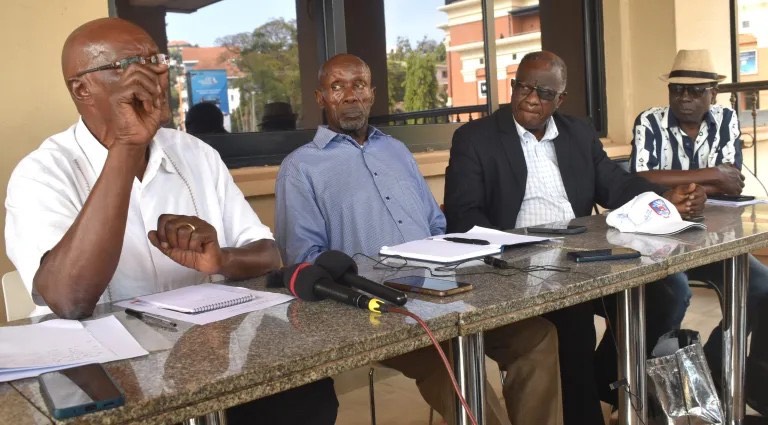
Photo courtesy.
SC Villa trustees defend use of UNRA compensation, announce March elections
SC Villa’s Board of Trustees has moved to clear the air on two key matters shaping the club’s future: the fate of compensation money paid by the Uganda National Roads Authority (UNRA) and the leadership roadmap following the expiry of the current club executive.
Addressing the media at City Oil, Kamwokya, Trustees chairman Gerald Ssendaula confirmed that the record 17-time league champions received Shs3.02 billion from UNRA as compensation for the takeover of Villa Park in Nsambya.
However, he stressed that the funds were never intended to bankroll routine club operations.
Instead, the trustees unanimously resolved to ring-fence the money and channel it into a long-term investment — the acquisition of land for the construction of a permanent home stadium.
“We received Shs3bn and 20m as compensation fees from UNRA for SC Villa Park,” Ssendaula said. “From this amount, we saw it as an opportunity for the club to build its own stadium, a true home.”
According to Ssendaula, the limitations surrounding Villa Park meant it could not be developed into a valuable long-term asset, making UNRA’s intervention a timely relief for the club’s broader ambitions.
Flanked by fellow trustees Franco Mugabe, Moses Matovu and Ivan Kawuma, Ssendaula revealed the compensation was placed in a fixed deposit account. The move has since paid off, with the funds earning approximately Shs34 million in monthly interest and growing to about Shs4.5 billion.
“This money came from a fixed asset and could not be used for recurring expenditure like day-to-day team activities,” he explained. “That is why we chose to protect and grow it.”
The trustees have since embarked on a search for about 21 acres of land. While SC Villa’s historical roots trace back to Masaka, Ssendaula noted that the club’s massive fan base in Kampala influenced the decision to look within or around the capital.
He added that the club has expressed interest in land government plans to procure for investors in the Kampala metropolitan area, with more clarity expected by the end of March.
Beyond infrastructure plans, the trustees also addressed governance concerns raised by former club president Ben Misagga, who questioned the legality of the current executive led by Hajji Omar Mandela.
Misagga had argued that Mandela’s four-year term expired on November 13, 2025, with no formal instrument issued to extend his mandate. Ssendaula acknowledged the concern, confirming that the executive’s term indeed lapsed in November.
“It is true that the club executive expired in November,” he said. “We realised this midway through the year and agreed to extend the arrangement up to the end of March 2026 because the league had just started and there were many ongoing activities, including national elections.”
He concluded by assuring stakeholders that elections will be held before the end of March, with the trustees set to convene the necessary meetings to ensure a smooth transition and clarity on who will steer the club’s day-to-day affairs moving forward.
⚽ Follow Pan-Africa Football across platforms for real-time news and stories.



